Εμφάνιση αναρτήσεων με ετικέτα ΑΡΘΡΑ / Elliott Larry. Εμφάνιση όλων των αναρτήσεων

Δευτέρα 8 Οκτωβρίου 2012

Economics: the failure of European monetary union has been abject


ΠΗΓΗ: GUARDIAN
by Larry Elliott
When he was leader of the Conservative party, William Hague once likened membership of the euro to being trapped in a burning building with no fire exit. It was an apt description, as young people in Greecewould testify: in a country that has already contracted by more thanGermany did during the Great Depression, the jobless rate for Greeks under 25 is 55%.
Little wonder then that Antonis Samaras, the prime minister of Greece, is warning that his country has been pushed to the limit and that there is, as with Weimar Germany, the risk of democracy collapsing.
Little wonder, either, that Spain, only just behind Greece in the youth unemployment misery stakes, is wary of seeking the help offered by theEuropean Central Bank. Unlimited buying of Spanish bonds by the bank will come at a heavy price: more austerity for a population already buckling under the strain.
A study of hundreds of recessions dating from the 19th century shows that most are short, sharp affairs. They are like heavy colds, nasty but quickly over. Every now and then, however, the cold turns into something much more serious and the longer it lasts the more serious it gets.

Τετάρτη 20 Ιουνίου 2012

Germany surrenders over eurozone bailout fund


Πηγή: Guardian
by Larry Elliott
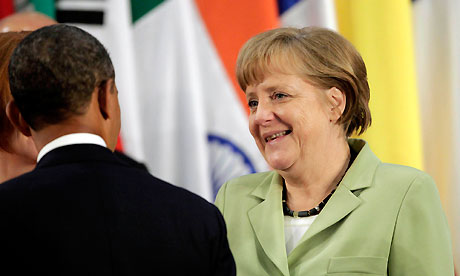
If the stories coming out of Los Cabos are correct, the Germans have surrendered. Angela Merkel, it appears, has agreed that Europe's bailout fund should be used to buy up Spanish bonds. This is precisely the show of "shock and awe" that the markets have been demanding, and the immediate response will undoubtedly be positive. All the financial firepower that Europe can muster will be used in an attempt to drive down Spain's borrowing costs from the 7%-plus level they have reached this week.
That, at least, is the talk. It is worth noting from the outset that Europe has failed to deliver on its fine-sounding rhetoric in the past. The detail of this deal may prove less impressive than the behind-the-scenes briefing, in which case the market reaction will be swift and brutal.
But let's assume that this is for real. Why would Germany be prepared to play fast and loose with the tough conditions that Berlin itself insisted on when the European Financial Stability Facility and its successor were created.
The rules say that the bailout funds should not take on the risks associated with buying up the debt of a member country unless it is part of an official European Union-International Monetary Fund programme. Although details are sketchy, this appears to be the sort of no-strings attached deal that Merkel has always steadfastly opposed.
So why is this happening? Not because Germany has come under fire at the G20 summit, although it has. Not because Merkel has changed her mind about the potential costs of such an arrangement for her own taxpayers. Rather, it is because the events of the past few weeks have left Germany with a binary choice: support emergency action to prop up the eurozone's fourth biggest economy or watch monetary union slide into the abyss. Berlin does not want to be blamed for destroying theeuro "project", and recognises that a crisis involving Spain (with Italy waiting in the wings) is of a whole different order or magnitude to one affecting Greece, Portugal and Ireland.
What this means is that European policymakers have decided to take on the bond vigilantes. The hope is that they can drive 10-year Spanish bond yields out of the danger zone, take the pressure off the creaking Spanish banking system, and thus avoid the need for Madrid to seek formal help from the EU and the IMF.
This, for certain, is a high stakes game. Part of Europe's fighting fund has already been spent on bailing out Greece, Portugal and Ireland. Spain has also pledged funds to the EFSF and ESM, and these clearly cannot be spent buying up the country's own debt. The markets might decide that it is worth taking on Europe in the way that George Soros did in 1992, when he saw the pound as ripe for a killing.
That risk is exacerbated by the dire state of the Spanish economy, which is suffering from a long-lasting hangover after the bubble in its construction and property sectors in the years running up to 2007. With a tough austerity programme in place, the economy is still going backwards and house prices have further to fall. A lot further, in all probability. If the gamble fails, Spain will still need a bailout and Europe will have nothing left in the kitty for Italy. But in the circumstances, Merkel and her fellow eurozone leaders may think it is a gamble they have to take.

Παρασκευή 1 Ιουνίου 2012

Troubled Greece: fears of 'first domino' to fall as austerity is counted a failure


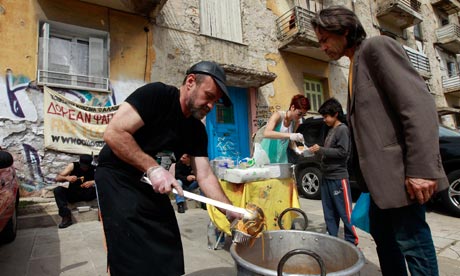
An Athens soup kitchen, pictured in April 2012, helps out citizens who have fallen on hard times. Photograph: John Kolesidis/Reuters


Larry Elliott, economics editor
guardian.co.uk, Thursday 31 May 2012


The soup kitchen opens at noon but long before then the queues start to form in the hot Athens sun. A couple of streets away from where sardines, red mullet and squid are piled high in the fish market, those down on their luck line up. While elsewhere life goes on seemingly as normal, students, jobless people, single parents and pensioners swallow their pride and wait patiently. They get two meals a day, at midday and 5pm. This is what a depression looks like.

At first blush, Greece seems no different from any other developed country. People sit in the city centre cafes sipping their iced coffees; yellow taxis cruise the streets; the shops are open for business. But different it is, and it is not hard to spot the signs that this is an economy that has contracted by 20% since the downturn began three years ago and that it is still falling.

You don't need to know that spending in the shops is down by a sixth over the past year; it is obvious from the empty cabs and those shops open but with no customers. You don't need to know that the official unemployment rate is well above 20% and youth unemployment is nudging 50%: it's obvious from the young men idling on street corners and openly dealing drugs.

Παρασκευή 25 Μαΐου 2012

Guardian: Mπλόφα, καρότο, μαστίγιο=τρομοκράτηση Ελλήνων


Πηγή:  defence.net

Ποιος θα τρομάξει, πρώτος, πιο πολύ; Αυτό είναι το παιχνίδι που παίζουν Ευρώπη και Ελλάδα. Κι αν ο στόχος της συζήτησης για σχέδια εκτάκτου ανάγκης στις χώρες της ευρωζώνης, εν όψει ενδεχόμενης εξόδου της Ελλάδας από το ευρώ, είναι να τρομοκρατηθούν οι Έλληνες και να παραμείνουν εντός, φαίνεται ότι αυτή η στρατηγική έχει αποτέλεσμα», γράφει ο Λάρι Ελιοτ στον Guardian.

"Η επόμενη φάση της μπλόφας, αν πρόκειται πράγματι για μπλόφα, θα είναι το καρότο, που θα ακολουθήσει μετά το μαστίγιο. Θα ακουστούν, ίσως, κάποια πράγματα υπέρ μιας χαλάρωσης των όρων του μνημονίου ως μέρος μιας πανευρωπαϊκής επιχείρησης για την ενίσχυση της ανάπτυξης.

Αλλά όχι ακόμη. Οι εκλογές στην Ελλάδα θα γίνουν τον Ιούνιο, και είναι νωρίς για να σταματήσει ο πόλεμος της προπαγάνδας. Εξ ου και η έκθεση από την Bundesbank που λέει ότι μια ελληνική αποχώρηση από το ευρώ θα ήταν «διαχειρίσιμη». Εξ ου και η διαρροή στο Reuters ότι μέλη της ευρωζώνης καταστρώνουν σχέδια εκτάκτου ανάγκης για να ελαχιστοποιήσουν τις επιπτώσεις στις δικές τους οικονομίες.

Δευτέρα 21 Μαΐου 2012

The euro is ripe for creative destruction


Guardian 20/5/2012
by Larry Elliott

The spectre of Lehman Brothers looms large in the world's financial markets. Memories of the chaotic days of September 2008 came flooding back as Alistair Darling appeared on TV amid reports of capital flight and bank runs.

Forget the idea that Europe's policymakers are better prepared this time than they were back then. Take with a pinch of salt the idea that they have a big enough war chest to cope with the consequences of a Greek exit from the single currency. The much-vaunted firewall is a Maginot line.

Events have moved quickly since the French and Greek elections a fortnight ago. Greek departure from the eurozone is now pretty much priced in by the markets, with the focus of attention on how bad the collateral damage will be. Expect the worst. Last week, pressure was mounting on Spain and its troubled banks. The idea that the European leaders who have been like rabbits in the headlight for the past two years can mastermind a clean break for Greece is utterly fanciful. The crisis will be messy, painful, prolonged and probably terminal.

Τρίτη 8 Μαΐου 2012

Eurozone crisis: democracy trumps austerity but will the euro survive?


Πηγή: Guardian
Larry Elliott

It happens like this. The election result in Greece means pro-austerity parties lack the parliamentary support and the moral authority to govern. Demands from Athens for the tough bailout conditions to be softened are turned down flat by the International Monetary Fund, the European Central Bank and the European Commission.

Political impasse in Greece leads to a second general election being called for next month. Angela Merkel makes it clear the next tranche of cash to keep Greek banks and the Greek state solvent will not be given unless the plan is adhered to in full. The strains on the single currency become intolerable; Greece leaves the euro and defaults, starting the process by which monetary union unravels.

In May 2010, when David Cameron and Nick Clegg were negotiating the terms of their coalition agreement and Greece received its first package of financial support, the idea that Europe was about to be gripped by a crisis that would put monetary union in peril was ridiculed. On Monday, as the euro fell on the foreign exchanges, the Greek stock market plunged and investors piled into the safe haven of German bunds, it no longer seems quite so far-fetched.

Τετάρτη 22 Φεβρουαρίου 2012

€130bn plaster leaves Greece independent in name only


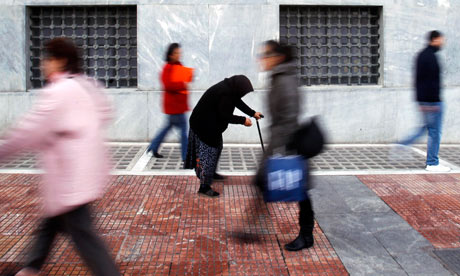
A woman begs in central Athens
A woman begs as shoppers walk by in central Athens as Greeks resigned themselves to the €130bn bailout. Photograph: Yannis Behrakis/Reuters
ΠΗΓΗ: GUARDIAN
by Larry Elliott
A stay of execution. The most expensive sticking plaster in the world. A rescue deal with shallow foundations. That was the snap assessment of the markets on Tuesday about the 4am deal struck in Brussels to spareGreece the indignity of going bust and to keep alive the myth that theeuro is working.
The pundits could be wrong. It is possible that the €130bn (£110bn) bailout will mark a turning point and in a decade's time Greeks will be looking back on the dark days of 2012 in the way that the newly prosperous Germans looked back in the 1960s to their war-ravaged economy in 1945.
It is all so simple: for a new wonder economy to arise in the Aegean what has to happen is for Greece's recession to end immediately, for the economy to have six consecutive years of strong growth from 2014 onwards; for the Greeks to submit to their eurozone partners' humiliating terms; for the bailout to be given the thumbs-up by the sceptical parliaments in Germany, Finland and the Netherlands, and for the assorted hedge funds, banks and insurers that make up Greece's private-sector creditors to accept a 53% "haircut" on their investments.

Κυριακή 19 Φεβρουαρίου 2012

Greece can slay its financial demons – but will it spare the euro?


ΠΗΓΗ: GUARDIAN
by Larry Elliott

There's a scene in The Lord of the Rings where the wizard Gandalf confronts the Balrog, a hellish monster, on a narrow bridge in the Mines of Moria. The battle ends with Gandalf smiting the bridge with his staff, sending the Balrog plunging into a fathomless abyss.
There's a twist to the tail, however. As the monster falls, one last swish of its whip curls round Gandalf's ankle and drags him down into the pit as well. Views may differ, in the context of the eurozone debt crisis, whetherGreece is Gandalf or the Balrog, but one thing is for certain; the risks of mutually assured destruction are high.
Both Greece and the hardline European countries demanding cast-iron assurances that they are not throwing good money after bad in a new €130bn (£108bn) bailout have the potential to shatter what, at best, is a fragile truce. The Greeks might decide they have had a bellyful, and that default and departure from the euro is preferable to endless austerity and the humiliation of colonial status.

Τετάρτη 8 Φεβρουαρίου 2012

Austerity is turning Germany into a basket case too


Now industrial production and export orders are declining even in Europe's powerhouse, as the austerity Berlin demands stifles its customers' spending

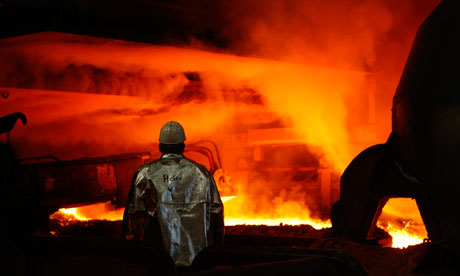
File photo of ThyssenKrupp worker controlling blast furnace in Duisburg
German steelworkers: the country's industrial production fell by 2.9% in December. Photograph: Ina Fassbender/Reuters

Wednesday 8 February 2012 18.39 GMT


Exports down by 4.3% in December. Industrial production down by 2.9% in the same month. An economy on the skids? It certainly looks that way. Are we talking about Greece? No. Portugal? Think again.
The economy in question here is Germany, which has started to post the sort of data that smacks of a double-dip recession in Europe's biggest economy.
Consider the evidence. Germany is an export-driven economy but its main markets – the rest of the eurozone, the UK, the US, China – have all seen a sharp slowdown in growth in the second half of 2011. During that period, the most significant German export was austerity, which has now come back to haunt Berlin through diminished demand for the industrial goods produced by the Mittelstand. Total export orders were almost 9% lower in the final two months of 2011 from their peak in June-July.
But the domestic economy is also suffering. Imports were down by 3.9% in December, so there is little hope that countries like Greece can export their way out of trouble, even if they accept the terms of their new bailout from the European Union and the International Monetary Fund.

Κυριακή 15 Ιανουαρίου 2012

Eurozone crisis: Troika's gunboats will get their way, at a cost


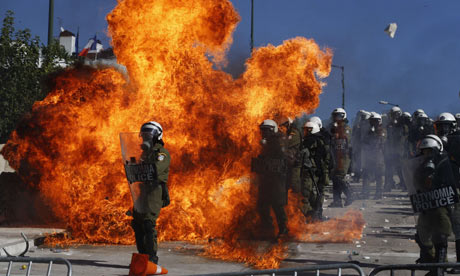
Demonstrators clash with riot police in front of the Greek parliament in Athens
Demonstrators clash with riot police in front of the Greek parliament in Athens. 'There is rising despair, sullen anger and a lot of fear. The mix is combustible,' says Prof Costas Lapavitsas. Photograph: Angelos Tzortzinis/AFP/Getty

The warships have been replaced by spreadsheets. Back in 1850,Greece knew it was in trouble when the Royal Navy arrived at Piraeus. This time, the pressure comes from banks, hedge funds and the team of officials of the International Monetary Fund (IMF), the European Central Bank (ECB) and the EU, who will take up residence at one of the swankier hotels in Athens.
For students of history, what is happening in Greece this week has echoes of the Don Pacifico affair, the classic case of British gunboat diplomacy in the mid-19th century. David Pacifico was a Portuguese Jew who had never set foot in Britain but had British citizenship by virtue of being born in Gibraltar. He became the Portuguese consul in Athens, where his house was burned down by an antisemitic mob. After unsuccessfully appealing to the Greek government for compensation, he asked Britain for help, and his case was taken up, with gusto, by the foreign secretary, Lord Palmerston. A naval squadron was sent to the Aegean, Greek ships were seized and Piraeus, Athens' port, was blockaded. Don Pacifico got his compensation.