Εμφάνιση αναρτήσεων με ετικέτα ΑΡΘΡΑ / ΛΙΤΟΤΗΤΑ. Εμφάνιση όλων των αναρτήσεων

Τρίτη 14 Μαΐου 2013

NYT: How Austerity Kills


ARLY last month, a triple suicide was reported in the seaside town of Civitanova Marche, Italy. A married couple, Anna Maria Sopranzi, 68, and Romeo Dionisi, 62, had been struggling to live on her monthly pension of around 500 euros (about $650), and had fallen behind on rent.
David Stuckler, a senior research leader in sociology at Oxford, and Sanjay Basu, an assistant professor of medicine and an epidemiologist in the Prevention Research Center at Stanford, are the authors of “The Body Economic: Why Austerity Kills.”
Because the Italian government’s austerity budget had raised the retirement age, Mr. Dionisi, a former construction worker, became one of Italy’s esodati (exiled ones) — older workers plunged into poverty without a safety net. On April 5, he and his wife left a note on a neighbor’s car asking for forgiveness, then hanged themselves in a storage closet at home. When Ms. Sopranzi’s brother, Giuseppe Sopranzi, 73, heard the news, he drowned himself in the Adriatic.
The correlation between unemployment and suicide has been observed since the 19th century. People looking for work are about twice as likely to end their lives as those who have jobs.
In the United States, the suicide rate, which had slowly risen since 2000, jumped during and after the 2007-9 recession. In a new book, we estimate that 4,750 “excess” suicides — that is, deaths above what pre-existing trends would predict — occurred from 2007 to 2010. Rates of such suicides were significantly greater in the states that experienced the greatest job losses. Deaths from suicide overtook deaths from car crashes in 2009.

Κυριακή 3 Φεβρουαρίου 2013

Spain: the pain of austerity deepens (Guardian)


Unemployment in Spain already stands at 26%. Small crowds gather outside supermarkets seeking discarded food. And life is about to get tougher still

Giles Tremlett
The Guardian, Tuesday 1 January 2013


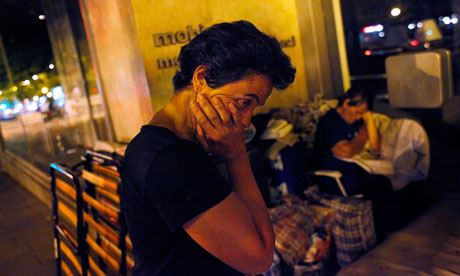
A family prepares to sleep on the street in Madrid. Oxfam says that by 2022, 38% of the Spanish population could be in poverty. Photograph: Susana Vera/Reuters
Forget, for a moment, the Greek tragedy. The tale of social woe set to play out in Spain this year is both bigger and more important to the world. For the drama of rescuing the euro, or letting it sink, will be played out on Spanish soil.

That is not to say Spaniards will have it worse than Greeks, though Eurostat figures show only Bulgaria and Romania now have a higher percentage of people deemed at risk of poverty. Spain's economy will shrink, once more, by 1.5% – a dramatic enough figure, though one most Greeks would happily settle for. But Spain represents a quantitative leap in Europe's ongoing tale of misery. Its economy is five times bigger than Greece's – accounting for 12% of the eurozone. And there are almost twice as many Spaniards as there are people in bailed-out Portugal, Ireland and Greece together.

As Spain enters another year of recession, Europe's politicians offer only one remedy. It must swallow more of the harsh medicine of austerity. But will it survive the cure? And will the spiral of decline really come to a halt towards the end of the year, as Prime Minister Mariano Rajoy promises?

Σάββατο 12 Νοεμβρίου 2011

EU austerity drive country by country


ΠΗΓΗ: BBC
Europe is in the grip of tough austerity measures - some of the deepest public sector cuts for a generation.
The colossal debts and rock-bottom growthof eurozone "periphery" nations - especially Greece and Italy - have hammered market confidence. The interest rates (yields) on their sovereign bonds have soared, making it hard or even impossible for them to borrow in international markets.
The fear now is that it may be impossible to cut Greece's debt mountain - about 340bn euros (£297bn; $478bn) - to manageable proportions without some sort of default.
Greece, Ireland and Portugal have all received massive bailouts from the EU and International Monetary Fund (IMF).
The 27 EU member states aim to cut deficits to a maximum of 3% of GDP by the financial year 2014-15, so what belt-tightening measures are the countries taking?